Communication Components: Precision Structural Parts, Silicon Carbide, AlSiC – Advanced Material Components – Manufacturer
Aluminum Silicon Carbide(AlSiC), a ceramic matrix composite made of aluminum and SiC particles, features uniformly distributed aluminum stably bonded within the SiC structure. Compared to traditional Metal Matrix Composites, AlSiC offers superior structural stability and optimized material properties.
It cleverly combines the excellent thermal conductivity and lightweight of aluminum with the low thermal expansion coefficient, high rigidity, and high hardness of silicon carbide.
Aluminum Silicon Carbide Structural Parts Specification
| Silicon Carbide | volume fraction Customized |
| Density(g/cm3) | 2.82-3.02 |
| Elastic Modulus(GPa) | 95-220 |
| Bending Strength(MPa) | Customized |
| Tensile Strength (MPa) | Customized |
| Coefficient of Thermal Expansion(10-6/K) | 7-17 |
| Thermal Conductivity(W/m·K) | Customized |
Product Features
-Low density and high specific rigidity
-High rigidity and high strength
-Excellent thermal shock resistance
-Excellent wear resistance
-Surface Machinability and MetalizationApplications
-High-Power Electronic Devices
-Thermal Management
-Adjustable coefficient of thermal expansion (CTE)
-Excellent thermal conductivity and heat dissipation performance
Application Fields
-Semiconductor packaging
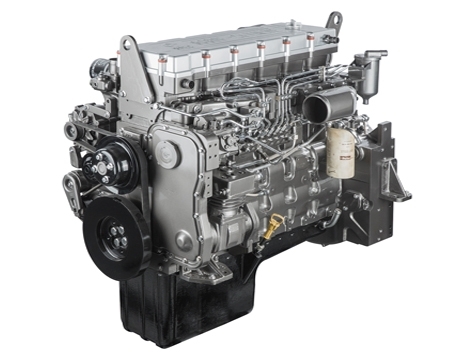
-Automotive industry
-EADS
-Optical system Precision Instrument
-Racing engine pushrods
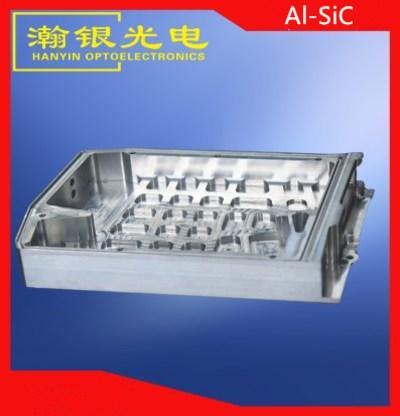
-AlSiC box structure parts
-Robot engine putters
-Helicopter accessories
Aluminum Silicon Carbide Structural Parts FAQs
Q1: What are the primary applications of Al-SiC Structural Parts?
Aerospace: Lightweight structural components and heat-resistant parts.
Automotive: Brake rotors, pistons, and engine blocks.
Electronics: Heat sinks, housings, and thermal management systems.
Industrial Equipment: High-strength and wear-resistant machinery components.
Q2: What are the key properties of Al-SiC Structural Parts?
Lightweight: Maintains a low density with high mechanical strength.
High Wear Resistance: Ideal for components in high-friction environments.
Thermal Stability: Performs well under high temperatures.
Excellent Thermal Conductivity: Efficiently dissipates heat.
Low Coefficient of Thermal Expansion (CTE): Provides dimensional stability in multi-material assemblies.
Q3: What are the typical sizes and shapes of Al-SiC Structural Parts?
Parts can range from small precision components, such as heat sinks, to larger structural parts, such as panels or frames, depending on the manufacturing process.
Simon Hu
Marketing Manager
Phone/WeChat: 86 186 3797 2531
Reposted for informational purposes only. Views are not ours. Stay tuned for more.